



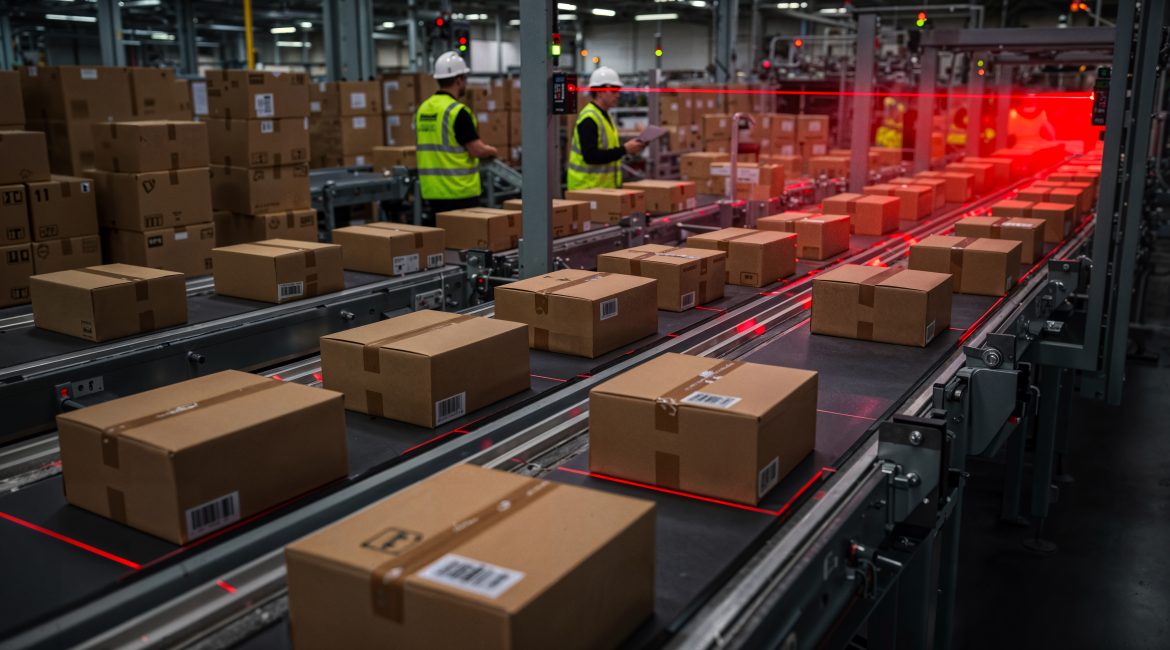
AI, Real-Time Data, and 2D Codes Will Transform Goods Control and Movement
Toward the end of the decade, distribution centers will assume a strategic role that goes far
beyond the simple safeguarding of goods. This is demonstrated by warehousing and inventory
management trends heading toward 2030, according to global market research firms, which
point toward operations that are increasingly connected, predictive, and data-driven.
According to projections by Fortune Business Insights, the global inventory control software
market will scale from 2.75 billion dollars in 2026 to 5.52 billion by 2034, driven by industrial
automation, the boom of e-commerce, and the urgency for end-to-end visibility across the
supply chain.
In parallel, analytical firms such as Mordor Intelligence point out that the Internet of Things (IoT),
RFID technology, cloud platforms, and artificial intelligence (AI) will be the disruptive tools
dictating the pace in the modernization of logistics infrastructure.
Based on these market indicators, we analyze the seven key trends that will transform
warehouse operations toward the turn of the decade.
1). From Reactive to Predictive Inventory
For decades, stock control was limited to recording inflows and outflows to know current
availability; today, that reactive vision is obsolete. The Mordor Intelligence report anticipates a
definitive transition toward platforms that integrate AI and Machine Learning algorithms, capable
of anticipating market behaviors.
By crossing historical sales, seasonality, and promotions with real-time external variables, these
systems optimize the supply chain by suggesting precise replenishments. The goal is to
completely eliminate stockouts and over-inventories before they affect cash flow.
This trend points to a radical change in software evolution, where the tool is not limited to
reporting what happened in the past, but instead projects future scenarios to guide operational
decision-making.
2). Real-Time Visibility Will Replace Static Inventories
One of the biggest headaches in today's supply chain remains the lack of precision regarding
the exact location of each SKU; in fact, Fortune Business Insights identifies this opacity as one
of the main barriers to efficiency, a critical problem in organizations that still depend on manual
processes or traditional spreadsheets.
According to reports from the firm, the mitigation of this risk arrives with technological maturity:
"The integration of IoT sensors, RFID tags, and mobile devices connected directly to the
Warehouse Management System (WMS) allows the automated recording of every movement of
goods at the exact instant it occurs."
Heading toward 2030, the strategic value will not be in knowing how much stock is on the
balance sheet, but in instantaneously answering three critical questions for omnichannel
operations:
– Where the product is
– What purchase order it is committed to, and
– What physical condition it is in
3). 2D Codes Will Turn Every Product Into a Data Source
The visibility revolution is also transforming labeling; on the doorstep of the global Sunrise 2027
initiative, GS1 is driving the definitive adoption of two-dimensional codes (such as the logistics
standard QR), designed to overcome the limitations of the traditional GTIN.
According to data from the GS1 Mexico website, these identifiers do not just record the product
code, but encapsulate critical data in real time:
– Batch number
– Expiration date
– Serial number, and
– Robust digital links
This density of information directly strengthens the pillars of traceability, simplifies reverse
logistics schemes, and accelerates product recall alerts.
For intralogistics operations, this evolution translates into pure efficiency: the capacity to extract
a complete history with a single scan.
In the near future, this will drastically optimize the control of sensitive inventories, a critical
benefit for highly regulated sectors such as the pharmaceutical and the food and beverage
industries.
4). The Cloud Will Connect All Inventories
Perhaps one of the most interesting insights provided by market research firms heading toward
2030 is that inventory is ceasing to be managed per facility to be managed as an integrated and
dynamic network.
Cloud solutions are not the future, they are the operational standard; in fact, Mordor Intelligence
reports that these platforms already concentrated 65.5% of the global market at the close of
2025, and will maintain the highest expansion rate in the sector due to their intrinsic flexibility.
The great advantage of cloud architecture lies in its capability to break operational isolation,
natively interconnecting distribution centers (Cedis), physical stores, e-commerce marketplaces,
and the core ERP systems of companies.
For decision-makers, this connectivity translates into a unified view of stock in real time; this
allows orchestrating distributed inventory strategies from a single centralized console,
optimizing omnichannel fulfillment and speed up response times to demand fluctuations.
5). Omnichannel Operations Will Change Warehouse Design
The accelerated growth of e-commerce has stopped being a consumer trend to become the
main architect of new logistics infrastructure.
This expansion is categorized by Fortune Business Insights as one of the most powerful
engines behind the stock control software market, forcing companies to migrate toward
integrated ecosystems.
For their part, analyses from Mordor Intelligence highlight that omnichannel operations are
imposing highly dynamic operating models.
Today, a single purchase order can be filled indistinctly from a central Cedi, a physical store
(acting as a dark store), or an urban micro-distribution center (micro-fulfillment center).
Under this scenario, the true challenge of intralogistics no longer lies in the passive
safeguarding of goods, but increasingly, it will depend on the system's capacity to determine,
through real-time algorithms, from which node of the network it is most efficient, fast, and
profitable to fulfill each order.
6). Integration Will Replace Isolated Systems
A transversal axis crossing industry analyses is the urgency for massive technological
integration. The era of platforms operating in isolation is over; the future belongs to end-to-end
connected ecosystems.
Both Fortune Business Insights and Mordor Intelligence agree that inventory management
systems can no longer be independent tools; their strategic value lies in their capability to
communicate natively and bidirectionally with the company's core ERP, financial modules,
points of sale (POS), Transportation Management Systems (TMS), and e-commerce platforms.
This absolute interoperability completely eliminates data duplication and critical errors derived
from manual entries. By democratizing information, 360° visibility is enabled, allowing finance,
purchasing, and logistics to make strategic decisions aligned under a single source of
information.
7). The Warehouse Will Generate Intelligence for the Entire Supply Chain
The most interesting transformation we will experience between now and 2030 will not occur in
physical infrastructure, but in the strategic role of the operational space. Market reports are
unanimous: the warehouse will stop being a passive link for safeguarding to become a nerve
center for data generation and business intelligence.
Under this new model, every movement of goods, scan, and intralogistics flow will feed
advanced analytical models in real time. Such visibility will allow industry leaders to:
– Identify predictive bottlenecks
– Maximize service levels (Fill Rate)
– Optimize working capital invested in stock, and
– Strengthen the strategic planning of the entire supply chain
In other words, value will no longer be measured by the available square meters to store
products, but by the quality and volume of data it is capable of producing and actioning.
What will be the biggest challenge for warehouses and inventory management in
2030?
Automation and predictive intelligence set the pace for the future, but digitization alone will not
solve structural inefficiencies; therefore, the transition toward the next level of operational
maturity will face significant friction along the way.
For example, Fortune Business Insights warns that the main drag on competitiveness will
continue to be the dependence on legacy systems, deep-rooted manual processes, and
persistent opacity in stock control.
In this regard, Mordor Intelligence points out that the true success of any technological
investment will not depend on the software itself, but on three critical pillars:
– Native interoperability between platforms
– Governance and data quality
– Robust industrial cybersecurity protocols
Added to this software ecosystem is the challenge of physical identification infrastructure; for,
according to GS1 Mexico, the global migration toward 2D codes will be a hybrid and gradual
process.
Faced with these challenges, for the coming years, operations must be prepared to manage the
daily coexistence between the traditional barcode and new two-dimensional standards, which
will demand flexibility in scanning and capture systems at distribution centers.
Heading toward 2030, the biggest challenge will not be the availability of technology, but the
capacity of organizations to integrate it harmoniously, securely, and without disrupting business
continuity.
Roadmap Toward the Next Logistics Decade
The race toward 2030 has already begun; the projections of analytical firms and leaders in
standardization make it clear that intralogistics success will not depend on the isolated adoption
of tools, but on a deep cultural and structural transformation.
The warehouse of the future will depend less on increasing square meters and more on
improving the quality of the information that sustains the operation.
For Chief Supply Chain Officers (CSCOs) and operations managers, the true strategic
imperative lies in beginning an orderly transition today, which implies:
– Auditing legacy systems
– Prioritizing data governance
– Training talent in the use of predictive tools, and
– Preparing infrastructure for the imminent era of two-dimensional scanning
Reports point out that the warehouse of the future will stop being evaluated as a safeguarding
cost center, to consolidate itself as the engine of profitability and resilience for companies.
Therefore, those organizations that manage to break technological silos and assimilate data
intelligence as their main asset will be the ones leading the market in the next decade.